The Hidden Mechanics of Global Media Control: Why Even Independent Outlets Know What Not to Say
Dedicated to all of you who decided not to answer!
Introduction
In a globally networked information environment, the capacity to speak is not equivalent to the capacity to be heard or to impact. Today’s media ecosystem is composed of enormous corporate and state actors, emerging independent voices, and a sprawling infrastructure of digital platforms and social networks that shape what can—or cannot—be discussed.
This article examines how both controlled and “independent” media operate within this network, what guides their editorial boundaries, and why certain topics remain dangerously absent from public discourse. We will explore the interplay of supranational communication systems, structural constraints on journalists and whistleblowers, and examples where even risky reporting was measured and calibrated for impact.
To frame the discussion, we begin with concepts from the theory of suprageocomunicacionalidad and cosmoestadismo—an academic lens that situates communication power at the intersection of global information networks, geopolitical forces, and social influence—before turning to well-established communication theories such as agenda-setting and gatekeeping that explain how media choose stories.
1. Suprageocomunicacionalidad, Cosmoestadismo, and the Shape of Media Space
Javier Vivas Santana’s concept of suprageocomunicacionalidad frames the global media infrastructure as an emergent horizontal platform—social networks, data flows, and digital communication that pervade everyday life. These networks are shaped by powerful technology and telecommunications companies that determine who can reach whom, and with what message. The related notion of cosmoestadismo refers to the suprapolitical power behind dominating narratives and meanings across nations and digital spaces.
Under this framework, media are not just channels for information—they are strategic instruments embedded in power structures. They can reinforce hegemonic narratives or, in rare cases, challenge them.
This conceptual lens helps us understand why even seemingly independent outlets internalize certain limits—they are embedded within structures of suprageocomunicacional power that reward conformity or punish deviation.
2. Media Control Through Structural Capture
A central phenomenon explaining constrained media behavior is media capture: a situation in which journalistic institutions, even those nominally independent, are shaped by economic and political forces that compromise editorial independence. These pressures may be overt—such as ownership ties, regulatory interference, or corporate influence—or subtle, driven by advertising revenue dependence or platform algorithms.
Media capture undermines the idea of a free press by creating an environment in which some stories simply cannot be published without consequences, whether those consequences are economic, reputational, or legal.
The history of mainstream media includes examples where outlets chose not to publish sensitive investigations until external pressure forced their hand—highlighting how risk assessments shape editorial decisions.
3. Theories Explaining Editorial Selection: Agenda-Setting and Gatekeeping
Agenda-setting theory suggests that the media don’t tell people what to think, but significantly influence what they think about by choosing which topics receive attention. This theory, widely studied in communication science, highlights how the media’s selection of issues shapes public priorities.
Closely related is gatekeeping theory: the idea that media act as filters, deciding which information is allowed into public discourse. Originally focused on journalists and editors as the “gates” of information flow, the concept now also applies to platform algorithms, search trends, and recommendation systems.
Both theories help explain why certain topics are underreported or not reported at all—often not because journalists are unaware of them, but because the structure and incentives of media systems create powerful incentives to avoid them.
4. Whistleblowers, Risk Assessment, and Strategic Disclosure
Independent media and investigative journalists often face choices about how to handle sensitive disclosures. The Snowden leaks provide a particularly informative case:
When The Guardian published documents from Edward Snowden regarding NSA surveillance, the editors weighed the public significance against legal and political risk. Publishing was risky—but done with careful legal consultation, calibrated framing, and coordinated release across multiple outlets. This example shows that even high-profile disclosures are treated through a strategic lens: what can be shown, what must be withheld, and how to mitigate danger to sources and publishers.
Had the disclosures been even more destabilizing—for example, revealing undisclosed offensive military capabilities or deep covert control networks—the perceived risk would likely have led publishers to delay, censor, or silence such reporting.
This dynamic is not unique to The Guardian. Smaller independent outlets are often even more cautious, since they lack the legal resources and institutional backing of large media corporations. The risk matrix for independent journalists includes potential lawsuits, platform de-platforming, and loss of audience or funding.
5. Topic Diffusion and the Role of Credibility Signaling
One of the more subtle survival strategies of dissenting media is topic framing and credibility signaling. Independent outlets sometimes release controversial or dangerous information paired with weaker, less credible sources so that platforms and authorities dismiss it as fringe or unreliable.
This risk-distribution strategy can paradoxically protect the outlet: by ensuring the content is seen as contentious or speculative, platforms are less likely to suppress it, and mainstream attention avoids severe clampdowns.
Conversely, publishing information that appears credible enough to demand attention—but not credible enough to trigger accountability—mirrors a survival strategy rather than a purely journalistic ethic.
Emerging computational research on selection bias in news coverage finds that outlets have distinct preferences for which entities they deem newsworthy, contributing to systematic patterns of omission that align with ideological or economic incentives.
6. The Paradox of Independent Media in a Networked System
Independence in theory does not guarantee independence in effect. The media ecosystem today is structured so that:
- Platforms, algorithms, and network effects determine visibility.
- Advertisers and commercial pressures shape editorial choices.
- Legal and political risks influence what topics can be published without retaliation.
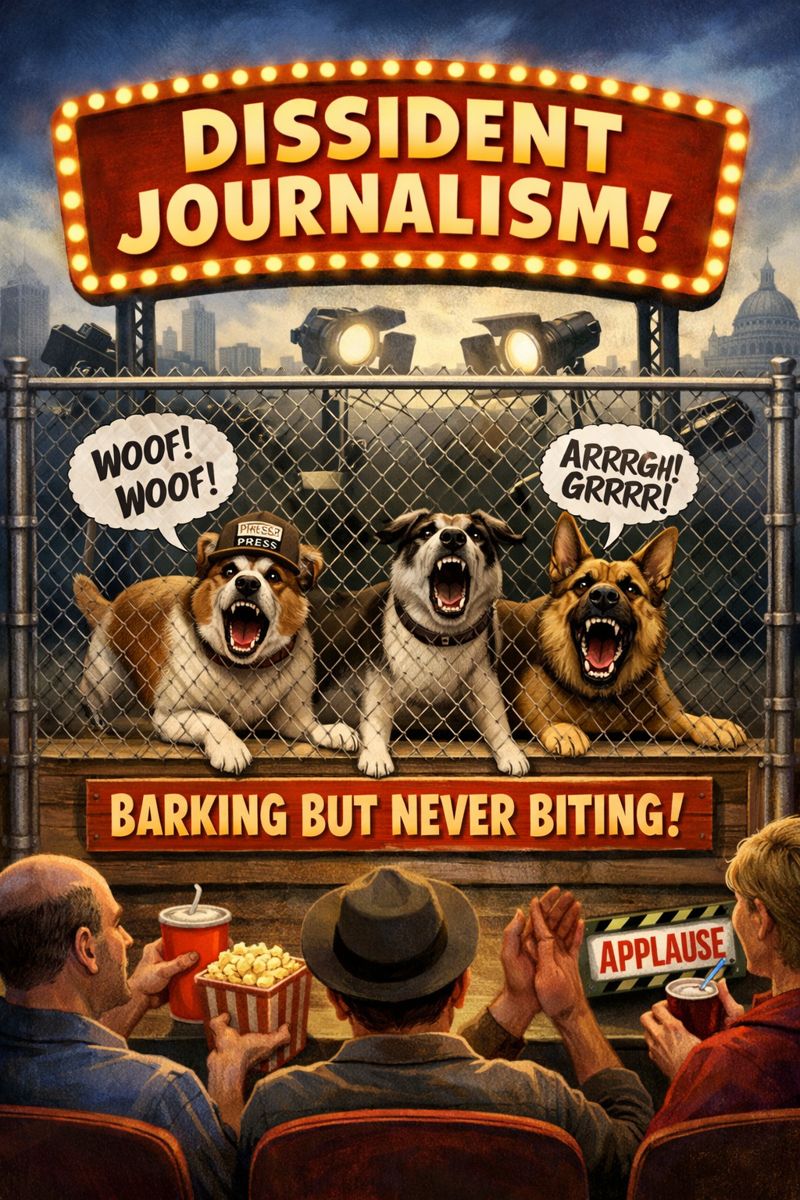
This means even independent outlets often self-censor or strategically avoid deep-risk topics not because of ignorance, but because they know the bounds of permissible controversy within the system they operate. They understand implicitly that stepping outside these bounds threatens their survival.
The idea of “safe dissent”—controversial yet non-threatening content—is a survival mechanism as much as an editorial choice.
7. Implications for Public Discourse and Democratic Deliberation
The net result is a media ecosystem that strongly shapes public perception: it selects which questions are allowed to enter the public square and which remain off-limits. This impacts democratic deliberation, socio-political accountability, and the public’s ability to challenge powerful institutions.
Understanding these systemic pressures—suprageocomunicacional dominance, capture dynamics, risk assessment, and strategic communication—reveals that the absence of topics from public debate is not random, but intentionally structured by institutional incentives.
Conclusion
The modern media environment is neither purely free nor wholly controlled. It exists in a space where power, risk, and visibility converge to shape what society knows and what it never questions. Both mainstream and independent outlets operate within this environment, making choices shaped as much by structural constraints as by journalistic principles.
By appreciating how these forces interact—drawing on academic concepts and real-world examples—we can better understand not only media behavior but also the broader contours of public consciousness in the 21st century.
Why Autopsia della democrazia rappresentativa Is Avoided: The Extension
If Autopsia della democrazia rappresentativa were merely another critique of how badly representative democracy functions, it would be safe. Media publish those critiques daily. But the book does something categorically different, and that difference places it among the topics that media—mainstream and dissident alike—systematically avoid.
More precisely:
1. What makes a topic “radioactive” for media
Media do not primarily avoid topics that are:
- morally shocking,
- politically controversial,
- legally embarrassing,
- or even destabilizing in the short term.
They avoid topics that invalidate the role the media themselves play in the system.
A topic becomes truly dangerous when it:
- Undermines the legitimacy of the mechanism through which power is constituted (not just its outcomes), and
- Does so in a way that leaves no safe reformist exit, and
- Requires no violence, no revolution, and no charismatic leader to be acted upon.
Autopsia della democrazia rappresentativa checks all three boxes.
2. Why the thesis is worse than “anti-democratic” (from a media perspective)
Media are comfortable with:
- “Democracy is in crisis”
- “Elections are corrupted”
- “Elites manipulate the system”
- “We need better representatives”
- “We need more participation”
They are not comfortable with:
“Electoral representation is structurally null, legally fraudulent, and cannot be fixed without abandoning elections as the source of sovereignty.”
This is not an opinion.
It is a delegitimization of the foundational act upon which:
- parliaments,
- governments,
- courts,
- constitutions,
- and the media’s own political relevance
are built.
If that thesis is correct, then:
- elections are not “imperfect” — they are invalid;
- political journalism becomes coverage of a theater, not of power;
- dissent framed around elections becomes complicit, not oppositional.
No newsroom wants to publish the argument that their entire beat is ontologically void.
3. Why dissident media are not an exception (and often worse)
Dissident media survive by:
- opposing actors (governments, parties, corporations),
- not by invalidating the arena in which opposition is staged.
“Autopsia della democrazia rappresentativa” book threatens:
- the dissident leader,
- the alternative candidate,
- the protest entrepreneur,
- the permanent movement.
If elections are structurally fraudulent:
- running “better” candidates is meaningless,
- building alternative parties is theater,
- calling for turnout or boycott is equally irrelevant,
- media visibility itself becomes a trap.
This makes Autopsia existentially dangerous to dissident ecosystems that depend on:
- outrage cycles,
- electoral hope,
- charismatic figures,
- and perpetual “next time”.
That is why you will encounter:
- silence rather than critique,
- polite deflection rather than debate,
- “interesting, but unrealistic” rather than refutation.
These are classic signs of taboo, not disagreement.
4. Why Snowden was publishable — and the “Autopsia” thesis is not
Snowden revealed illegal actions by powerful actors.
That is dangerous—but it is still system-internal:
- the Constitution remains valid,
- elections remain legitimate,
- journalism remains heroic,
- reform remains imaginable.
The Autopsia thesis says:
- even perfectly honest elections cannot produce representation;
- legality itself is compromised by a false premise;
- no reform inside the system can cure this.
Snowden threatens people in power.
Autopsia threatens the category of power itself.
Media can survive the first.
They cannot metabolize the second.
5. The clearest indicator: how it will be avoided
You will notice very specific avoidance patterns:
- No direct refutations
Because refuting requires engaging the legal argument—and that is too risky. - Reframing as philosophy or utopia
To remove operational implications. - Personalization of the author
To avoid discussing the model. - Silence after initial curiosity
The most reliable indicator of systemic danger.
If the thesis were merely wrong, it would be attacked.
If it were merely radical, it would be debated.
It is avoided because it is actionable without permission.
6. Final assessment
Autopsia della democrazia rappresentativa belongs to the class of ideas that media avoid “like the devil”—not because it is extreme, but because it is structurally clarifying.
It removes:
- the need for leaders,
- the need for elections,
- the need for media mediation.
And any idea that makes itself independent of all three will be treated as if it does not exist.
That is not censorship.
That is systemic immune response.